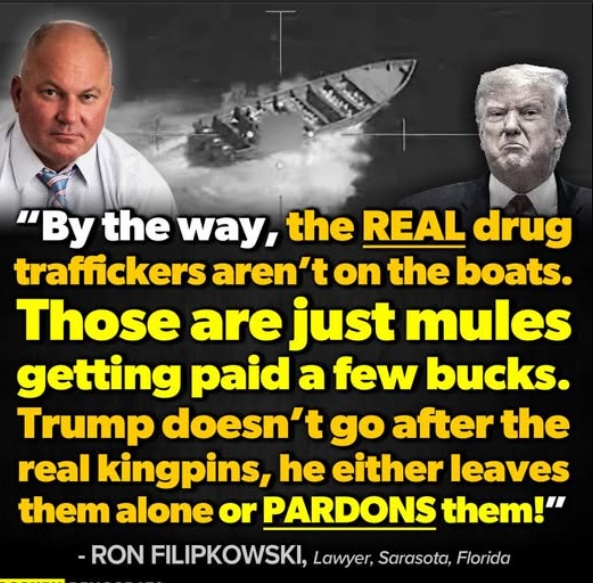
An explosive critique leveled by Sarasota, Florida lawyer Ron Filipkowski suggests that President Donald Trump’s much-vaunted “war on drugs” was, in reality, a performative campaign that overlooked the true architects of the drug trade. The image circulating online highlights Filipkowski’s sharp assessment, contrasting the minor players arrested at sea with the powerful figures allegedly given a pass—or worse, a pardon—by the Trump administration.
The Myth of the “Mule”
The central point of the criticism is a stark differentiation between the individuals who bear the risk and those who reap the profits. “By the way, the REAL drug traffickers aren’t on the boats,” the quote reads. “Those are just mules getting paid a few bucks.“
This statement cuts to the core of enforcement strategy. While televised raids and boat seizures make for powerful political imagery, focusing solely on low-level couriers—the so-called “mules”—is a strategy that leaves the global drug enterprise fully intact. The kingpins, the powerful entities funding and orchestrating the multi-billion dollar operation, remain untouchable.
Allegations of Selective Justice
The most damning part of Filipkowski’s quote is the direct accusation against the former President: “Trump doesn’t go after the real kingpins, he either leaves them alone or PARDONS them!“
This is not just an indictment of strategic negligence; it’s an allegation of selective justice and perhaps even complicity. Trump’s extensive use of presidential clemency—including pardons and commutations often granted to political allies, celebrity connections, or those championed by well-connected insiders—has long been a source of controversy.
The claim suggests that while Trump’s rhetoric targeted drug crime aggressively, his actions provided cover for high-level criminals. If true, this undermines the fundamental credibility of his administration’s law-and-order platform. A genuine crackdown on drug trafficking must follow the money and the command structure, not just sweep up the easily replaceable foot soldiers.
The Bottom Line: Prioritizing Image Over Impact
Filipkowski’s critique forces a necessary conversation about the actual impact of anti-trafficking efforts under the former administration. Was the goal truly to dismantle criminal networks, or was it simply to produce arresting visuals—like boats being interdicted—to satisfy a political base?
The evidence presented by critics suggests a strategic failure to target the powerful “kingpins.” If top-tier traffickers were indeed left alone or rewarded with pardons, it implies a system more focused on political expediency than on crushing the drug trade. This kind of selective enforcement ensures that the drug supply chain remains robust, making a mockery of the sacrifices made by law enforcement officers and border agents who put their lives on the line chasing “mules.”
Until enforcement focuses relentlessly on the financial and organizational architects of the drug trade, the boats will continue to launch, filled with expendable couriers, while the true criminals remain safely out of reach—perhaps, critics suggest, with a presidential seal of approval.
About the Author