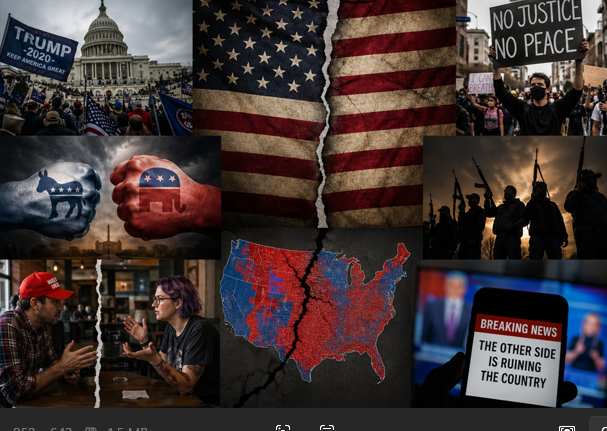
America is still the most powerful democracy in the world. It has a massive economy, strong institutions, and a long history of surviving crisis after crisis. But in recent years, one question that once sounded extreme is now being asked more often:
Is the United States starting to look like a country heading toward internal conflict?
This does not mean a repeat of the Civil War of the 1860s, with armies fighting across states and formal battle lines. The danger today looks very different. It is about collapsing trust, political violence, radicalization, institutional paralysis, and a growing feeling that fellow citizens are no longer fellow citizens at all.
That kind of breakdown can be just as dangerous.
When Political Opponents Become Enemies
A democracy works when people accept that the other side may be wrong, but still has the right to exist and compete for power.
That idea is weakening in America
More people now see the other political side not as rivals, but as a threat to the country itself. Many voters believe that if the other party wins, the nation will be ruined. Once politics becomes a battle between good and evil, compromise becomes almost impossible.
Instead of debating taxes, healthcare, or foreign policy, many people now believe they are fighting for the survival of America itself.
That is when politics becomes emotional, tribal, and dangerous
Elections No Longer End Arguments
In a stable democracy, elections settle disputes. One side wins, the other loses, and both accept the result.
That basic rule no longer feels guaranteed in the United States.
Large groups of voters distrust election outcomes. Some believe systems are rigged. Others believe courts, media, and institutions are controlled by enemies. Every major election now comes with fear that the losing side may reject the result.
When people stop believing they can change power through voting, they start looking for other methods.
History shows where that can lead.
Political Violence Is Becoming Normal
America has always had moments of violence, but what feels different now is how often it happens and how quickly people move on.
Threats against politicians are common. Judges receive intimidation. Party offices are targeted. Public officials need security. Online calls for violence spread rapidly.
Even worse, reactions are often tribal.
If violence targets one side, it is treated as an outrage. If it targets the other side, many stay silent. Some even justify it if it helps their cause.
That is a sign of moral decline. Once violence is judged by who benefits instead of what is right, the ground starts shifting under society.
Social Media Turned Conflict Into a Business
In the past, people argued with neighbors, coworkers, or family members.
Now they argue with millions of strangers while algorithms reward anger.
The more extreme a message is, the more attention it gets. The more insulting it is, the faster it spreads. Fear and outrage have become profitable.
This creates a false reality where people begin to think half the country is insane, evil, or impossible to live with. It also pushes unstable people toward radical ideas much faster than before.
Many Americans are no longer living in the same information world. They are living in seperate realities.
Weapons Make Everything More Dangerous
The United States is in a unique position. It combines deep political division with widespread access to firearms.
That means one angry person, one conspiracy theory, or one unstable mind can turn political rage into a national tragedy in minutes.
In many countries, extremism stays online. In America, it can become real very fast.
This does not mean most gun owners are violent. It means a highly polarized society with easy access to weapons carries more risk than many others.
Economic Frustration Needs Someone to Blame
Official economic numbers may look strong, but millions of Americans feel squeezed.
Housing is expensive. Debt is heavy. Healthcare costs are crushing for many families. Younger people often feel they will never catch up. Older people fear losing what they built.
When people feel trapped, they look for someone responsible.
Politics offers easy targets. Immigrants. Elites. Corporations. Liberals. Conservatives. The media. Billionaires. Washington.
Economic pain often becomes cultural anger.
One Country, Different Worlds
America increasingly feels like several countries living inside one border.
Urban and rural communities often have opposite values. Religious and secular Americans see social issues very differently. Some trust institutions, others despise them. Some embrace globalization, others see it as betrayal.
People watch different media, believe different facts, and teach their children different stories about what America is.
That kind of division is deeper than politics. It is a clash of identity.
It Is Not a Traditional Civil War
To be clear, America is not on the verge of two armies fighting each other across state lines.
The country still has strong courts, functioning elections, an enormous economy, and powerful institutions. Daily life for most people remains normal.
But modern conflict does not always look like old war.
It can look like repeated political attacks, lone wolf shootings, street clashes, constitutional crises, sabotage, refusal to accept election results, and permanent instability.
Instead of one giant explosion, it can be years of smaller fires.
The Biggest Danger Is Getting Used to It
Societies usually do not collapse in one dramatic moment. They decay slowly.
People get used to threats. They get used to lies. They get used to scandals. They get used to hearing public figures talk like enemies must be destroyed.
Once outrage becomes routine, warning signs stop feeling urgent.
That may be the most serious risk facing America today.
Can It Be Avoided?
Yes, but only if enough people decide the country matters more than party victory.
That would require leaders who calm tensions instead of inflaming them. Media that values truth over panic. Voters who reject political violence no matter who uses it. Institutions that remain trusted. Citizens willing to see opponents as Americans again.
None of that is impossible.
But it becomes harder every year the hostility continues.
America is still strong. It is still rich. It is still powerful.
The real question is whether it can remain united while so many people no longer trust each other.
About the Author