Enter your numbers to see how much a customer is worth over their lifetime, how that compares to what you pay to win them, and how long it takes to earn the money back.
LTV:CAC Calculator: Is Your Customer Acquisition Profitable?
Enter your numbers to see how much a customer is worth over their lifetime, how that compares to what you pay to win them, and how long it takes to earn the money back.
What is LTV:CAC?
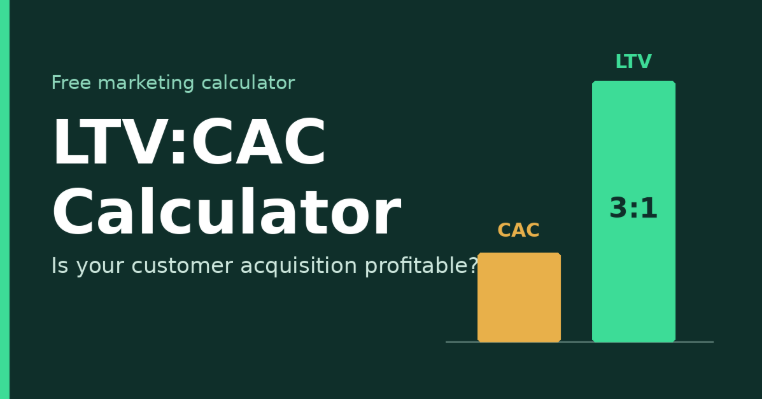
LTV:CAC compares two numbers: customer lifetime value (LTV), the gross profit a customer brings you over the whole relationship, and customer acquisition cost (CAC), what you spend to win that customer. A ratio of 3:1 means every $1 spent on acquisition returns $3 in gross profit.
The formulas
LTV = Average order value × Purchases per year × Lifespan (years) × Gross margin
LTV:CAC = LTV ÷ CAC
CAC payback (months) = CAC ÷ (monthly gross profit per customer)
Example: a $60 order, 4 times a year, for 3 years at 50% margin gives an LTV of $360. With a CAC of $70, the ratio is about 5.1:1 and the CAC is recovered in roughly 5.6 months.
What is a good LTV:CAC ratio?
| Ratio | What it usually means |
|---|---|
| Below 1:1 | You lose money on every customer. Fix this first. |
| 1:1 to 3:1 | Thin margins. Improve retention, pricing or ad efficiency. |
| 3:1 to 5:1 | Healthy and sustainable for most businesses. |
| Above 5:1 | Very profitable. You may be underinvesting in growth. |
These are rules of thumb. Businesses with long sales cycles or heavy upfront costs may need higher ratios, while cash-rich ones can accept lower ones to grow faster.
How to improve your LTV:CAC
- Raise LTV: increase repeat purchases with email and loyalty offers, add upsells and bundles, and improve onboarding to keep customers longer.
- Lower CAC: improve landing page conversion, target better audiences, and invest in organic channels such as SEO and referrals.
- Improve margin: negotiate supplier costs, adjust pricing, and cut delivery expenses.
Frequently asked questions
Should I use revenue or profit for LTV? Use gross profit. Revenue-based LTV overstates how much you can afford to spend on acquisition.
How is this different from ROAS? ROAS measures the revenue from a single ad campaign. LTV:CAC looks at the long-term profit from the customers those ads bring in, so it shows whether acquisition is truly worth it.
How often should I recalculate? Quarterly, and whenever you change pricing, channels or retention efforts.
What is LTV:CAC?
LTV:CAC compares two numbers: customer lifetime value (LTV), the gross profit a customer brings you over the whole relationship, and customer acquisition cost (CAC), what you spend to win that customer. A ratio of 3:1 means every $1 spent on acquisition returns $3 in gross profit.
The formulas
LTV = Average order value × Purchases per year × Lifespan (years) × Gross margin
LTV:CAC = LTV ÷ CAC
CAC payback (months) = CAC ÷ (monthly gross profit per customer)
Example: a $60 order, 4 times a year, for 3 years at 50% margin gives an LTV of $360. With a CAC of $70, the ratio is about 5.1:1 and the CAC is recovered in roughly 5.6 months.
What is a good LTV:CAC ratio?
| Ratio | What it usually means |
|---|---|
| Below 1:1 | You lose money on every customer. Fix this first. |
| 1:1 to 3:1 | Thin margins. Improve retention, pricing or ad efficiency. |
| 3:1 to 5:1 | Healthy and sustainable for most businesses. |
| Above 5:1 | Very profitable. You may be underinvesting in growth. |
These are rules of thumb. Businesses with long sales cycles or heavy upfront costs may need higher ratios, while cash-rich ones can accept lower ones to grow faster.
How to improve your LTV:CAC
- Raise LTV: increase repeat purchases with email and loyalty offers, add upsells and bundles, and improve onboarding to keep customers longer.
- Lower CAC: improve landing page conversion, target better audiences, and invest in organic channels such as SEO and referrals.
- Improve margin: negotiate supplier costs, adjust pricing, and cut delivery expenses.
Frequently asked questions
Should I use revenue or profit for LTV? Use gross profit. Revenue-based LTV overstates how much you can afford to spend on acquisition.
How is this different from ROAS? ROAS measures the revenue from a single ad campaign. LTV:CAC looks at the long-term profit from the customers those ads bring in, so it shows whether acquisition is truly worth it.
How often should I recalculate? Quarterly, and whenever you change pricing, channels or retention efforts.
About the Author