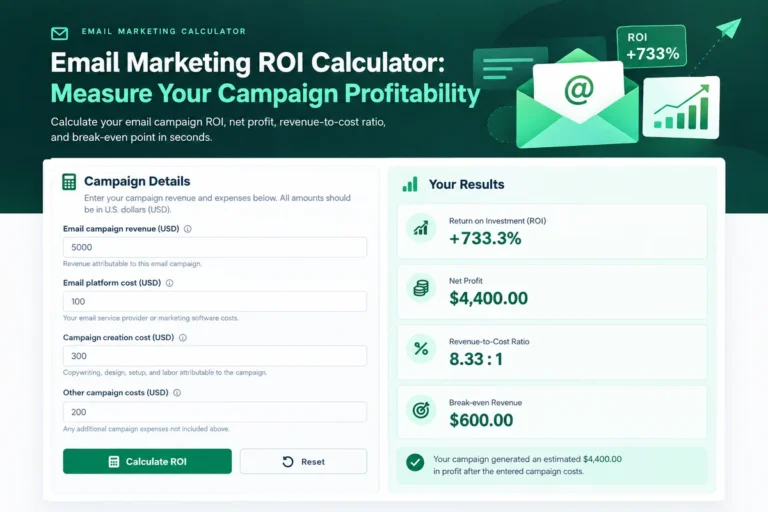
Email marketing can be a powerful way to generate sales, nurture leads, and build lasting customer relationships. But how much profit are your campaigns actually producing? Use our free Email Marketing ROI Calculator to estimate your return on investment, net profit, revenue-to-cost ratio, and break-even revenue in seconds.
Whether you run an online store, manage marketing for a small business, or work with email automation, understanding campaign profitability helps you make better decisions about where to invest your marketing budget.
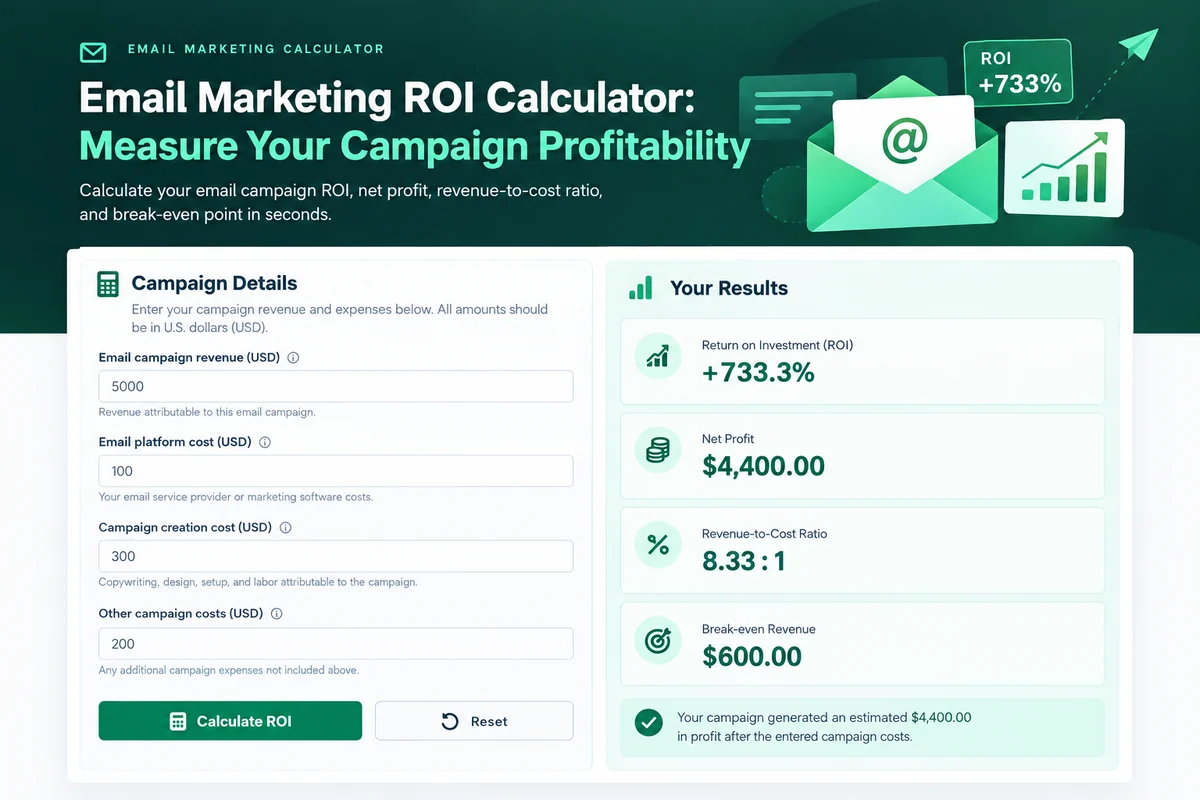
Free Email Marketing ROI Calculator
Enter your campaign revenue and expenses below. All amounts should be entered in U.S. dollars (USD). For a more accurate estimate, include the costs directly associated with running your campaign.
Email Marketing ROI Calculator
Calculate your campaign profit and return on investment.
Your Results
Why Email Marketing ROI Matters
Tracking email marketing ROI helps businesses determine whether their campaigns are generating enough revenue to justify the time, software, and resources invested in them. Without this measurement, a campaign with high open rates or click-through rates might look successful without actually generating profitable sales.
ROI also makes it easier to compare campaigns, identify profitable audience segments, evaluate promotions, and decide which strategies deserve more of your budget.
How to Calculate Email Marketing ROI
The standard ROI formula is:
Total campaign costs may include your email marketing platform, campaign production, design, copywriting, and other relevant expenses. Use consistent accounting rules when comparing different campaigns.
Example: Calculating Campaign ROI
Imagine your email campaign generates $5,000 in attributable revenue. Your email platform costs $100, campaign creation costs $300, and other campaign expenses total $200.
| Metric | Calculation | Result |
|---|---|---|
| Total campaign costs | $100 + $300 + $200 | $600 |
| Net profit | $5,000 − $600 | $4,400 |
| Email marketing ROI | ($4,400 ÷ $600) × 100 | 733.3% |
| Revenue-to-cost ratio | $5,000 ÷ $600 | 8.33 : 1 |
| Break-even revenue | Total campaign costs | $600 |
In this example, the campaign generates $7.33 in profit for every $1 spent, based on the costs entered. The campaign earns $8.33 in revenue for every $1 of cost. These are different measures: ROI tracks profit relative to costs, while the revenue-to-cost ratio compares total revenue with total costs.
Understanding Your Email Marketing ROI Results
1. Return on Investment (ROI)
ROI expresses the profit generated relative to campaign costs as a percentage. A positive ROI means revenue exceeds the costs entered. A negative ROI means those costs exceed revenue. An ROI of 100% means profit equals the amount spent.
2. Net Profit
Net profit in this calculator is campaign revenue minus the costs you enter. It is an estimate of campaign-level profit, not necessarily your business’s final accounting profit. Product costs, refunds, fulfillment, taxes, and other expenses should also be considered when relevant.
3. Revenue-to-Cost Ratio
This ratio shows how much revenue your campaign generates for every dollar of recorded campaign costs. For example, a ratio of 5 : 1 means $5 in revenue for each $1 spent. It does not mean $5 in profit.
4. Break-Even Revenue
Break-even revenue is the amount of campaign revenue needed to cover the costs entered in the calculator. At this point, the calculated campaign profit is zero and ROI is 0%, assuming no other costs.
What Is a Good Email Marketing ROI?
There is no single ROI target that works for every business. Results depend on the industry, product margins, customer lifetime value, audience quality, campaign objective, and which costs are included.
A campaign that generates immediate sales can be evaluated differently from a welcome sequence that nurtures new subscribers over several weeks. A campaign that produces repeat customers may also deliver value beyond its initial attributed revenue.
Instead of relying on a universal benchmark, compare your results with previous campaigns using the same calculation method. Monitor trends over time and check whether increased revenue is also translating into stronger profit.
5 Ways to Improve Your Email Marketing ROI
1. Segment Your Email List
Group subscribers based on their interests, purchase history, engagement, or stage in the customer journey. More relevant messages can help improve conversions and reduce unnecessary sends.
2. Test Subject Lines and Calls to Action
Test different subject lines, offers, layouts, and calls to action. Change one important variable at a time when possible, and evaluate results using conversions and revenue rather than opens alone.
3. Improve Landing Pages and Checkout
An email can attract interested visitors, but a confusing landing page or complicated checkout can prevent sales. Make sure the destination matches the promise of the email and works well on mobile devices.
4. Automate Relevant Customer Journeys
Welcome emails, abandoned-cart reminders, and post-purchase follow-ups can deliver relevant messages based on customer behavior. Track the costs and revenue associated with each automation separately where practical.
5. Measure the Full Cost of Your Campaigns
Include relevant platform fees, production time, creative work, and other expenses. If you omit significant costs, the resulting ROI may overstate profitability. Use the same attribution window and cost definitions when comparing campaigns.
Common Email Marketing ROI Mistakes
- Counting all sales as email-driven: Some customers might have purchased without receiving the email. Use a consistent attribution method and avoid claiming more credit than the evidence supports.
- Ignoring product and fulfillment costs: Revenue minus email campaign expenses is not the same as final business profit.
- Focusing only on open rates: Opens and clicks can provide useful context, but conversions and attributable revenue are more directly connected to financial performance.
- Comparing campaigns with different cost definitions: Consistent inputs make comparisons more meaningful.
- Ignoring refunds and cancellations: Where possible, use net attributable revenue after refunds and cancellations.
Frequently Asked Questions
How do you calculate email marketing ROI?
Subtract total campaign costs from attributable campaign revenue, divide the result by total campaign costs, and multiply by 100. If costs are zero, ROI cannot be calculated using this formula.
What is the difference between ROI and ROAS?
ROI measures profit relative to costs. Return on ad spend (ROAS) measures revenue generated for each dollar of advertising spend. ROAS does not automatically account for all campaign costs or product margins.
Should I include the cost of my email marketing software?
Yes, include the relevant share of your email platform or subscription cost. For a monthly platform fee shared across many campaigns, allocate the cost consistently to avoid double-counting it.
Can email marketing ROI be negative?
Yes. If the campaign revenue is lower than the costs entered, the calculated ROI will be negative. This can indicate that the campaign needs improvement or that its longer-term value should be evaluated separately.
Does this calculator include product costs and taxes?
Not automatically. You can include additional expenses in the other campaign costs field, but you must decide which costs are relevant. For business-level profitability, account for product costs, fulfillment, refunds, taxes, and other applicable expenses.
Is this email marketing ROI calculator free?
Yes. You can enter your campaign figures and calculate the results directly on this page without creating an account.
Start Measuring Your Email Campaign Profitability
Effective email marketing is about more than sending messages or increasing engagement. Understanding revenue, campaign costs, and profitability helps you make better decisions about your marketing strategy.
Use the free calculator above to evaluate your next campaign, compare results over time, and identify opportunities to improve your return on investment. For the most useful comparisons, keep your cost definitions and revenue attribution methods consistent.
About the Author