What has unfolded in Venezuela over the past 48 hours feels like a movie script that no one truly believed would play out in reality. The world woke up on Saturday, January 3rd, to the staggering news that one of South America’s largest nations had been struck by U.S. air forces, and its leader was literally snatched from the presidential palace.
The operation, codenamed “Absolute Resolve,” began under the cover of total darkness. At approximately 2:00 AM local time, the skies over Caracas were lit by a series of massive explosions. American stealth fighters and drones targeted key military installations, airfields, and communication hubs. However, the primary objective was Nicolás Maduro himself. Elite Delta Force units, supported by the CIA, reportedly stormed the heavily fortified Fuerte Tiuna complex. Within hours, Donald Trump posted a photo on social media showing Maduro blindfolded and wearing noise-canceling headphones aboard a U.S. warship.
As of today, January 4th, the country is in a state of total chaos. Caracas and several other major cities are suffering from widespread power outages. The streets have become an arena for clashes between regime loyalists and opposition groups celebrating the end of the “Maduro era.” Casualty reports remain deeply conflicting. While official U.S. sources speak of surgical precision and minimal civilian impact, independent reports and local activists paint a much darker picture. Some reports coming out of Caracas and the coastal regions suggest between 200 and 500 civilians were killed during the airstrikes—people who simply happened to be near strategic targets at the wrong moment. Hospitals are overwhelmed, and the supply of food and medicine has ground to a halt.
The political vacuum in Venezuela was filled almost instantly. The Supreme Tribunal and military authorities elevated Vice President Delcy Rodríguez to the role of acting president. She has taken an incredibly defiant stance. Her first televised address was filled with fury, as she labeled the attack a “cowardly aggression” and demanded immediate “proof of life” for Maduro. Rodríguez called for a total national mobilization, declaring that Venezuela would never again be a colony and would fight to protect its resources.
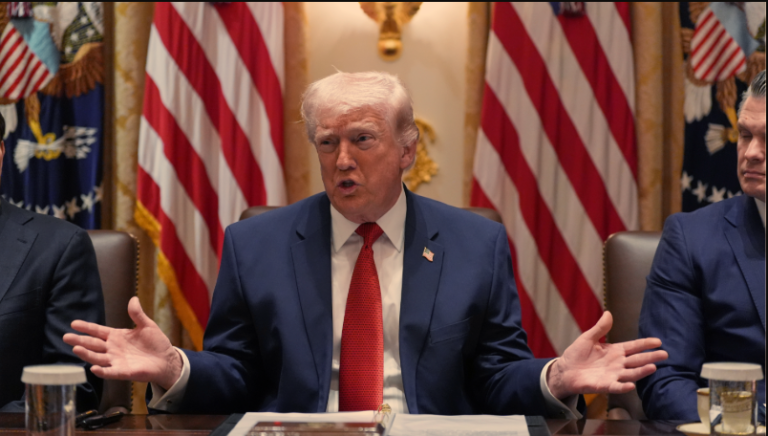
Trump’s response was swift. Speaking from Mar-a-Lago, he directly threatened Rodríguez, stating she would pay a “very high price” if she did not cooperate with American plans. Trump was crystal clear about his intentions: the United States would “run” Venezuela temporarily. This plan includes direct control over the nation’s oil industry, with American companies being sent in to “modernize and renovate” the infrastructure to restore financial flows.
Currently, the country is like a volcano about to erupt. On one side, the opposition calls for the recognition of a transition, while Delcy Rodríguez and the generals loyal to her prepare for a long resistance. China and Russia have already condemned Washington’s actions, calling them a dangerous precedent and a flagrant violation of international law. As Maduro is flown toward a federal court in New York to face narco-terrorism charges, Venezuela remains on the brink of civil war under the shadow of American warplanes.
The situation is extremely volatile, and every hour brings new information. One thing is certain—the map of South America was rewritten overnight, and the consequences for energy markets and global security are only beginning to be felt.
Here is the continuation of the analysis in English, focusing on what is likely to unfold in the critical weeks following Maduro’s capture.
Forecast: What to Expect in Venezuela in the Coming Weeks?
As the world continues to process the shocking footage from Caracas, the true trial for the region is only just beginning. The next few weeks are likely to be defined by three parallel processes: a fierce political purge, an economic “occupation,” and the looming risk of guerrilla warfare.
The first and most urgent question is the survival of Delcy Rodríguez at the top. Although Trump initially hinted at a willingness to work with her, her sharp rhetoric and refusal to surrender the symbols of power have placed her directly in the crosshairs. The most likely scenario for the next 14 days is massive pressure on the Venezuelan military to carry out an internal coup against her. Secretary of State Marco Rubio has already signaled that the U.S. is ready to work with “remaining leaders” if they make the “right decision.” This suggests that in the coming weeks, we will witness intense back-channel negotiations with generals, offering them amnesty and the protection of their wealth in exchange for total submission and the removal of Rodríguez loyalists.
On the economic front, a “petroleum invasion” is imminent. Trump has already stated that American companies will enter the country with billions of dollars in investments. Expect the U.S. administration to issue special licenses in the coming weeks for giants like Chevron and ExxonMobil to take over operations at refineries and oil fields in the Orinoco Belt. The goal is clear: a rapid restoration of production to flood the market with cheap oil and drive down global fuel prices. While this will be framed as “rebuilding Venezuela,” in practice, it will be the establishment of an American energy protectorate.
However, the most dangerous aspect remains security. Maduro may be in New York, but thousands of armed “colectivos” (paramilitary groups) and members of Cuban intelligence remain on the ground. In the coming weeks, a shift toward urban guerrilla warfare is highly probable. Attacks against oil infrastructure and American interests could force Washington to deploy actual ground troops for “order maintenance”—an option Trump has already refused to rule out.
Internationally, Russia and China will scramble to save their billions of dollars in Venezuelan debt. Moscow is expected to increase its military presence in Cuba or Nicaragua as a “reciprocal response,” bringing Cold War-style tensions directly to the U.S. borders.
Venezuela is entering a period of “controlled chaos.” Whether this leads to a democratic transition under the leadership of Edmundo González and María Corina Machado, or the country becomes a long-term conflict zone under U.S. administration, depends entirely on how deep the cracks in the Venezuelan military run and how determined Trump remains in his quest to “Make Venezuela Great Again” on his own terms.
About the Author