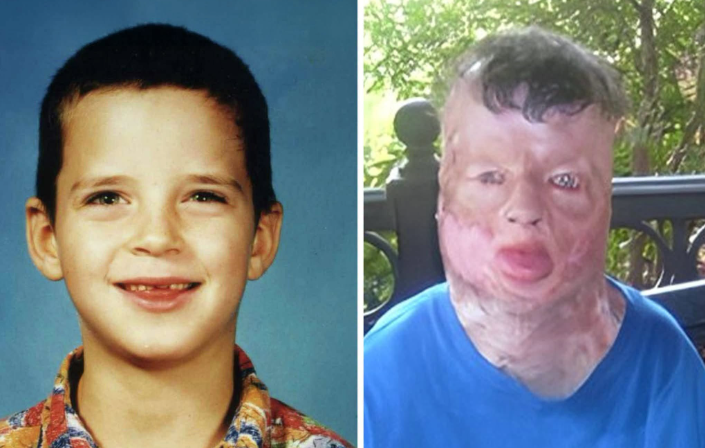
On June 28, 1998, eight-year-old Robbie Middleton left his home in the small town of Splendora, Texas, with no idea that his life was about to change forever. Instead of his birthday being a happy childhood memory, it marked the beginning of one of the most harrowing criminal cases in modern Texas history.
According to facts later established in court, the boy was ambushed in a wooded area, doused with gasoline, and set on fire. Robbie suffered burns over more than 99 percent of his body. Doctors gave him almost no hope of survival.
Despite the bleak prognosis, he survived. What followed was years of grueling medical treatment, hundreds of surgeries, and painful rehabilitation. Throughout this ordeal, Robbie became a symbol of extraordinary willpower and resilience for both his medical teams and everyone who knew him.
An Investigation Gone Cold
Back in 1998, Robbie pointed to Don Collins—then 13 years old—as his attacker. An investigation was launched, and Collins was detained for a time, but the charges were eventually dropped due to insufficient evidence to proceed with a prosecution. As a result, the case remained cold for years.
A New Testimony Before His Death
In 2011, as Robbie’s health took a sharp turn for the worse, he recorded a video deposition. In it, he once again named Don Collins as his attacker.
For the first time, Robbie also spoke about an alleged sexual assault that he said had occurred about two weeks before the burning. It was this testimony that ultimately prompted authorities to reopen the case. During the trial, the prosecution argued that the attack was carried out to silence the young victim about the prior abuse.
A Death Ruled a Homicide
Robbie Middleton passed away in 2011, shortly before his 21st birthday. According to medical examiners, the aggressive illness that led to his death was directly linked to the severe burns he sustained in 1998. Consequently, his death was officially ruled a homicide, enabling prosecutors to charge Collins with murder.
The Trial
In 2015, a jury found Don Collins guilty. Although he was only 13 at the time of the crime, he was tried as an adult following a special judicial hearing. Due to his age at the time of the offense, the maximum sentence was capped at 40 years in prison—the exact sentence handed down by the court. The ruling was later upheld on appeal.
During the trial, prosecutors presented testimonies from individuals who claimed that Collins had made confessions or threats regarding the attack over the years. These statements formed a key part of the evidence reviewed by the court.
A Legacy That Remains
For Robbie’s family, the verdict cannot undo a stolen childhood or erase years of suffering. His mother fought tirelessly to ensure his story would not be forgotten, and her family’s efforts played a vital role in getting the investigation reopened years later.
Robbie Middleton’s story remains one of the most heartbreaking cases of child abuse ever to reach American courts. It stands as a stark reminder of how hard justice can be to obtain—especially when years of medical battles, uncertainty, and constant struggle stand between the crime and the final verdict.
Though Robbie did not live to see the final legal outcome, his own testimony became the cornerstone of the case and played a decisive role in reopening the investigation that finally brought justice.
About the Author